

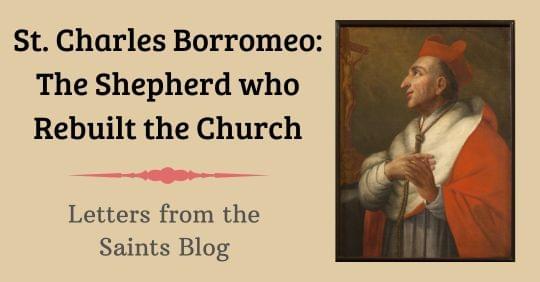
In the history of saints who have helped shape the Catholic Church, few figures embody pastoral zeal, reforming courage, and personal holiness like St. Charles Borromeo (1538–1584). Living during one of the most tumultuous eras in Church history—the time of the Counter-Reformation--Charles emerged as a living model of what a true shepherd should be: self-sacrificing, tireless, deeply prayerful, and utterly devoted to the salvation of souls.
Yet beyond the familiar stories of reform and resilience lies a lesser-known side of Borromeo—a man of humility and quiet acts of love amid the grandeur of ecclesiastical reform. Before exploring that hidden anecdote, it is worth recounting the remarkable journey of this saint who reshaped the Church from within.
The Making of a Reformer
Born into nobility on October 2, 1538, in Arona, Italy, Charles came from the distinguished Borromeo family, whose wealth and influence reached into the highest circles of the Renaissance world. His uncle, Giovanni Angelo Medici, would later become Pope Pius IV, a connection that would propel Charles into ecclesiastical prominence at an early age.
From childhood, Charles displayed an unusual gravity of spirit. When his father tried to secure for him a benefice (an income-producing Church position) at the age of twelve, Charles insisted that the income should go not to him but to the poor—an early indication of his moral clarity and detachment from worldly gain. He was educated in canon and civil law at the University of Pavia, where his studious habits and discipline earned him a reputation as both brilliant and humble.
When his uncle ascended to the papacy in 1559, Borromeo was called to Rome and soon became the Pope’s Secretary of State and a cardinal, even though he was only in his early twenties. Although this might strike one as rank nepotism, in Charles' case it was a very smart decision by the pope to bring his intelligent, hard-working, and holy nephew to the Holy See. Most men would have been swept away by the honors, the wealth, and the power of such a position. But Charles was not like “most men.” He saw his rise not as privilege, but as a responsibility—a divine summons to reform the Church from within.
Want to learn more about the saints?

Take a Free Email Course on the Saints.
The Council of Trent and the Renewal of the Church
At the time Borromeo entered Church leadership, the Church was reeling from the shockwaves of the Protestant Revolt. Many clergy had become lax, seminaries were almost nonexistent, and the faith of the people had been weakened by corruption and confusion. The Council of Trent (1545–1563) was convened to address these crises, but progress was slow, and implementation was uncertain.
Charles was charged with organizing the third and last session of the Council which took place from 1562 to 1563.. He pushed tirelessly for clarity in doctrine, discipline in clergy, and a renewed spiritual life in the faithful. His administrative genius and moral determination were instrumental in finalizing the Council’s decrees in 1563—a monumental achievement that reshaped Catholic life for centuries. In addition, after the Council, Charles played a large role in the development of the Catechism which presented the teachings of the Church with emphasis on the decrees promulgated during the Council.
When Pope Pius IV died in 1565, Borromeo’s destiny took an even more decisive turn. He was appointed Archbishop of Milan, one of the largest and most influential dioceses in Europe. Milan had been without a resident bishop for nearly 80 years, and its clergy were notoriously undisciplined. What Borromeo found upon his arrival was a church in disarray--spiritually impoverished and morally adrift.
And so began one of the most extraordinary episcopates in the history of the Church.
A Shepherd Among His Flock
Borromeo approached his mission with relentless energy and holy focus. He instituted seminaries to properly form priests—a revolutionary idea at the time. He enforced clerical discipline, ensuring that priests lived lives of integrity and prayer. He visited every parish in his diocese, even the most remote mountain villages, often traveling on foot or mule through treacherous weather.
He reformed monasteries, founded schools, and established the Confraternity of Christian Doctrine (CCD) to teach the faith to children. His vision of pastoral care was holistic—combining spiritual renewal with education, moral reform, and concrete works of charity.
His presence was not always welcomed. Many resisted his reforms, and he faced fierce opposition—even assassination attempts—from clergy and monks who resented his strict enforcement of discipline. Yet Borromeo persevered, always responding to hostility with charity. His motto, Humilitas (humility), became not merely a word but a way of life.
Get advice and guidance from the saints

What is Letters from the Saints?
✉️ One fascinating saints snail mail letter per week
😇 Real letters written by saints such as St. John of the Cross, St. Joan of Arc, St. Francis of Assisi, and St. Gemma Galgani
ℹ️ Notes that provide background information on the letter, the saint, and faith lessons
📪 A letter in your mailbox that you look forward to receiving
🖃 Printed on parchment paper and sent with a real stamp
🎁 Also makes for a fun and unique gift
The Candle of Forgiveness
Among the many accounts of Charles Borromeo’s life, one lesser-known, yet deeply revealing, anecdote occurred during the Plague of 1576–1577, when Milan was struck by a devastating outbreak of the bubonic plague. While civil authorities fled the city, Borromeo stayed behind, walking the streets barefoot in sackcloth, carrying a cross, and tending to the dying. He organized care for the sick, fed the hungry, and personally buried the dead when no one else would.
It was during this time of great suffering that a particular incident occurred—an act of quiet heroism that rarely makes it into the grand narratives.
One evening, after spending the day organizing care for plague victims, Borromeo returned to his residence utterly exhausted. As he entered the chapel for his nightly prayer, he discovered that one of the candles had been stolen—an ordinary beeswax candle, but one that had been given to him by a poor widow who had saved for weeks to offer it as a gift.
When the servant found the candle missing, he was furious and began to search for the thief. A few hours later, a young man—pale, thin, and trembling—was brought before the archbishop. The thief, it turned out, had stolen the candle out of desperation to sell it for a few coins to buy food for his family.
Rather than scolding him, Borromeo knelt down, placed his hand on the man’s shoulder, and said quietly, “My son, you have done wrong, but hunger drives even the weakest to folly. Take this candle, and another one besides. But promise me you will not steal again. God’s mercy burns brighter than any wax we light in His house.”
Then Borromeo handed the man two fresh candles from the altar. The thief wept openly, kissed the archbishop’s hand, and left that night with both forgiveness and food—Borromeo had ordered a meal to be sent to his family.
This small act of mercy, remembered by a servant who later recorded it in his notes, captures the saint’s heart more profoundly than any decree or council. His reforms were not merely about rules—they were about conversion, compassion, and seeing Christ in the poor.
The Plague Years: A Saint Among the Dying
Borromeo’s leadership during the plague was nothing short of heroic. When the city government fled Milan, he took personal charge of relief efforts. He converted his palace into a hospital, sold his personal belongings—including his bed and vestments—to buy food and medicine, and continually exposed himself to contagion while visiting the sick.
He set up outdoor altars so that people could attend Mass safely from their windows. He walked through the streets carrying the Blessed Sacrament, blessing the dying, and comforting those in despair.
Witnesses recalled that his prayers and processions brought hope to a city drowning in fear. While many clergy succumbed to panic, Borromeo’s courage and calm became a source of strength for thousands. His charity during the plague earned him not just reverence but deep affection among the people of Milan.
Let the Saints Letter Club Help You Teach Your Kids the Faith

Help your kids grow in the faith with monthly letters from:
Every month your child will receive a snail mail letter with:
😇 An illustrated letter written by the saint telling his or her story
✂ Fun, hands-on activities which build on the letter and teach about our holy faith
🧁 A tasty, easy-to-make, recipe based on the saint or the saint's region of the world
❤️ A simple service project which will help your children live out their faith
✉️ All stuffed into an envelope and sent to your door (Mailed anywhere in the world!)
The Inner Life of a Saint
Behind the public image of reformer and administrator, Borromeo cultivated a profound spiritual life. He spent hours in prayer, often kneeling before the Blessed Sacrament late into the night. He practiced personal austerities, fasted frequently, and lived simply despite his noble birth.
His letters reveal a man deeply aware of his own weaknesses and completely dependent on God’s grace. “We must meditate before, during, and after everything we do,” he once wrote. “The life of a minister of God should be a continuous meditation upon Christ.”
To his priests, he offered practical advice that remains timeless: “Be gentle, patient, and humble. Let your presence be such that it leads others to Christ, not to yourselves.”
In Borromeo’s spirituality, reform began in the heart. The Church could not be renewed by decree alone—it had to be renewed through holiness.
His Final Years and Legacy
Exhausted by years of unrelenting labor, fasting, and travel, St. Charles Borromeo’s health began to fail in his mid-forties. Yet he refused to slow down. In November 1584, after returning from a pastoral visit, he was stricken with fever. Surrounded by his priests, he received the sacraments with serene joy and whispered his final words:
“Behold, I come.”
He died at the age of 46 on November 3, 1584, in Milan. The entire city mourned him deeply, and within a generation, his memory became synonymous with holiness and reform. Canonized in 1610 by Pope Paul V, St. Charles Borromeo remains one of the patron saints of bishops, seminarians, and catechists.
The Relevance of St. Charles Borromeo Today
In an age still marked by division, moral confusion, and spiritual hunger, St. Charles Borromeo stands as a model for all who seek renewal in the Church and in their personal faith. He shows that reform begins not with condemnation but with compassion—not with power, but with prayer.
His life reminds us that holiness is not a distant ideal but a concrete reality, lived in fidelity to one’s vocation, in courage amid opposition, and in mercy toward the weak. Whether confronting corruption in the Church or comforting the poor in plague-ridden streets, Borromeo saw every task as a chance to make Christ visible.
And perhaps that stolen candle—the one he turned into an act of mercy—shines as the most fitting symbol of his life. For St. Charles Borromeo did not simply light candles of reform; he became one—burning himself out in love for God and His people, until all that was left was the light of Christ.
Did you enjoy this story about St. Charles Borromeo? Sign up to receive a free saint story every week via email.
You might also like to read ...
Feast Day: November 4th (Memorial)
Patron saint of spiritual directors
Patron against ulcers
Patron saint of catechists
Patron saint of catechism writers
Patron against colic
Patron against abdominal pain
Patron saint of apple orchards
Patron saint of catechumens
Patron against intestinal disorders
Patron against stomach diseases
Patron saint of seminarians
Patron saint of bishops
Patron saint of clergy
Patron saint of confessors